
Read Sui Gas Meter Guide:
Let’s face it: getting a high gas bill is stressful, but feeling powerless to verify the reading is even worse. You shouldn’t have to just trust that the meter reader got it right. The best way to protect your budget from incorrect charges is to take control and learn how to Read Sui Gas Meter yourself.
It might look complicated with all those dials and numbers, but we promise it’s much simpler than it seems. This comprehensive guide will break down the process step-by-step—from reading the digits correctly to understanding how those numbers turn into the final MMBTU charges on your SNGPL or SSGC bill.
The Basics – How to Read Sui Gas Meter Correctly
Think of your gas meter like your car’s odometer. It tracks the cumulative volume of gas that has flowed into your house since installation.
Identifying Your Meter Type and Avoiding the Red Digits
The first, and most crucial, step is knowing what to look at, and what to ignore.
- Locate the Display: Find the meter and clear away any dust or spiderwebs.
- Ignore the Red Digits: Whether you have an older dial meter or a newer digital one, the numbers in red (or after a decimal point) represent small fractions of gas. SNGPL and SSGC only bill you for the whole cubic meter units. When you Read Sui Gas Meter, only focus on the black (or white) numbers.
- Digital Meters: These are the easiest. Simply write down all the digits from left to right, stopping exactly before the red numbers or the decimal point.
- Dial Meters (The Clock Analogy): These have multiple small dials that turn in opposite directions. For each dial, always write down the number the needle has just passed. If the needle is pointing exactly at a number (say, ‘5’), look at the dial to its right. If that dial hasn’t passed zero, you must use the lower number (‘4’) for the current dial.
The 4-Step Process to Read Sui Gas Meter Accurately
Write down the black numbers exactly as they appear. This is your Current Meter Reading in cubic meters (m³).
Beyond the Meter – Calculating Your Bill’s Consumption
This is where many consumers get confused. Why does the bill use MMBTU when you Read Sui Gas Meter in m³? The answer is that you pay for energy, not just volume.
- Volume (m³): The amount of physical space the gas takes up (what your meter measures).
- Energy (MMBTU): The amount of heat the gas contains (what you actually pay for).
The company uses two factors from your bill to make this conversion: GCV and a simple division.
Step-by-Step Calculation to Match Your Read Sui Gas Meter Data
Here is how you can use your reading to find the MMBTU on your bill:
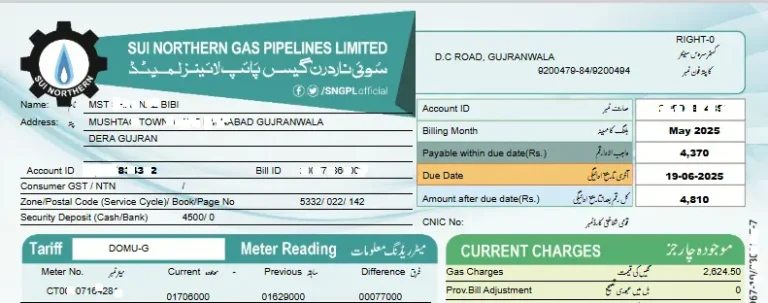
- Find Total Consumption (m³): Subtract your Previous Reading (found on last month’s bill) from your Current Reading.
- Example: Current Reading (12345) – Previous Reading (12245) = 100 m³
- Convert to Hm³: The utility companies use Hecto cubic meters (Hm³), which is just m³ divided by 100.
- Example: 100 m³ / 100 = 1.00 Hm³
- Find Your GCV: Locate the Gas Calorific Value (GCV) on your bill. This value (e.g., 950 or 1000) is the “quality factor” of the gas in your area.
- Calculate MMBTU: This is the final step to match the unit on your bill.
$$\text{MMBTU} = \frac{\text{Consumption in Hm³} \times \text{GCV}}{1000}$$
Using our example: $(1.00 \text{ Hm³} \times 950) / 1000 = **0.95 \text{ MMBTU}**$.
This number, 0.95 MMBTU, is the exact figure the company uses to apply the tariff slabs. If your bill’s consumption doesn’t match this number, you know something is wrong!
Spotting Errors – Use Your Read Sui Gas Meter Data to Fight High Bills
Learning to Read Sui Gas Meter is your insurance policy. If your bill shows a huge jump, but your calculated consumption is low, here is what likely happened:
- Estimated Bills: If the meter reader couldn’t access your meter, the company estimated your usage. Your next bill will be a massive “adjustment” when the reader finally gets in.
- Prevent This: Always ensure the meter is accessible. Take a photo of the meter every month on the expected reading date.
Final Tips to Master Your Read Sui Gas Meter Habit
- Keep a Log: Write down the reading and date in a small notebook or your phone every month. This history is undeniable proof if you need to file a complaint later.
- Check for Leaks: If you Read Sui Gas Meter late at night (when all appliances are off) and see the numbers still moving, you may have a gas leak. Report this immediately!

Frequently Asked Questions (FAQs)
Q1: Why does my bill use MMBTU when I Read Sui Gas Meter in m³?
You are buying energy, not just volume. MMBTU is the international unit for energy. The company converts your volume (m³) into MMBTU using the GCV factor so that everyone is charged fairly based on the actual heat value of the gas they receive.
Q2: What are the red numbers when I Read Sui Gas Meter?
The red numbers or digits after the decimal point represent fractions of a cubic meter. Since SNGPL and SSGC only bill in whole units, you can safely ignore them. They are there for technical accuracy but do not count toward your monthly billed consumption.
Q3: Can I submit my own reading to prevent an estimated bill?
Yes, many regions and providers now offer the option to submit a photo of your meter reading through their website or app, especially if you know the meter reader won’t be able to access it. This is highly recommended to ensure your bill is based on actual usage.
Q4: What should I do if the meter reader never comes and my bill is estimated?
If you receive a bill marked “Provisional” or “Estimated,” it means the reader couldn’t access your meter. This is risky because the estimated amount is often low, leading to a huge “Adjustment” bill later. The best action is to contact your nearest Customer Facilitation Center (CFC) immediately. You can inquire why the reading was missed and ask for a special meter reading visit. The Provisional Billing issue can be resolved within 3-4 working days once you contact the billing zone directly.
Q5: My meter is broken, leaking gas, or has stopped. What is the process for replacement?
This is an emergency, and you must report it immediately.
- Safety First: If you smell gas, open windows, turn off the main valve outside, and call the SSGC/SNGPL emergency helpline (usually 1199) right away.
- Replacement: If the meter is visibly faulty (broken glass, stopped, or slow), file a Sui Gas Complaint for “Meter Malfunction.” The company will schedule a replacement. If the issue is a “Nil/Minimum Consumption Meter,” the resolution timeline is officially within 2 working days after they receive your request.
Q6: How often does the GCV (Gas Calorific Value) factor on my bill change?
The GCV (Gas Calorific Value) factor, which determines the energy content of the gas you receive and is used when you Read Sui Gas Meter for calculations, is reviewed and determined periodically. It doesn’t change every month, but it is subject to revision based on the quality of gas flowing through the network. You should treat the GCV printed on your latest bill as the current factor for your calculations, as it is officially approved by the regulatory authority.